

The 2-Step Framework That Stopped Me From Turning My Kids Into Emotional Punching Bags
The podcast I’d been ignoring for months told me exactly what I needed to hear.

I need to tell you about a night last week that I’m not proud of.
I’d been sick for days, overwhelmed at work, and running on the kind of exhaustion that makes you highly emotional.
By the time I got home, I had nothing left. And instead of admitting that, I took it out on my kids.
It wasn’t a raised voice this time. Usually, that’s my signature. I was just being mean. Vindictive, even. Saying things designed to make a 6-year-old feel small because I couldn’t handle my own frustration.
I could hear myself doing it, and I kept going.
Afterwards, I was lying in bed and felt a level of shame that was painful.
Embarrassed. Defeated. Angry at myself.
And underneath all of it, one brutal realisation: I was treating my children like emotional punching bags because I didn’t know how to put my own resentment down.
That night, I finally pressed play on a podcast I’d been following on Instagram but never actually listened to. It changed how I handle every triggered moment since. Here’s what I learned.
The Podcast I'd Been Ignoring for Months Said the Quiet Part Out Loud.
It was the Calm Parenting Podcast by Kirk Martin (Episode #492).
I’d seen his clips on Instagram for months, always saving them, never listening. That night, scrolling at 10 PM because I couldn’t sleep from the guilt, I saw a clip where Kirk described my exact situation. A parent who’s stressed, sick, overwhelmed, and releasing that pressure onto the people who are smallest and safest to hurt.
He said something that stopped me cold.
I’m paraphrasing, but the core idea was this: most of us are operating from a hidden belief that goes, “I need my kids to behave the way I want them to behave, so that I can behave.”
In other words: if you misbehave, you’re making me angry. You’re the reason I’m losing control.
And the reframe hit me like a truck.
The goal isn’t to get your kid to regulate so you can stay calm. The goal is the opposite: when their world is out of control, you’re the steady one.
You’re the one who says, “I’m okay, and I can be here for you.”
That’s the job. Not reacting well. Being the anchor. And I’d been doing the opposite. I had been the storm.
De-Escalate First, Discipline Later: A Framework for Triggered Dads
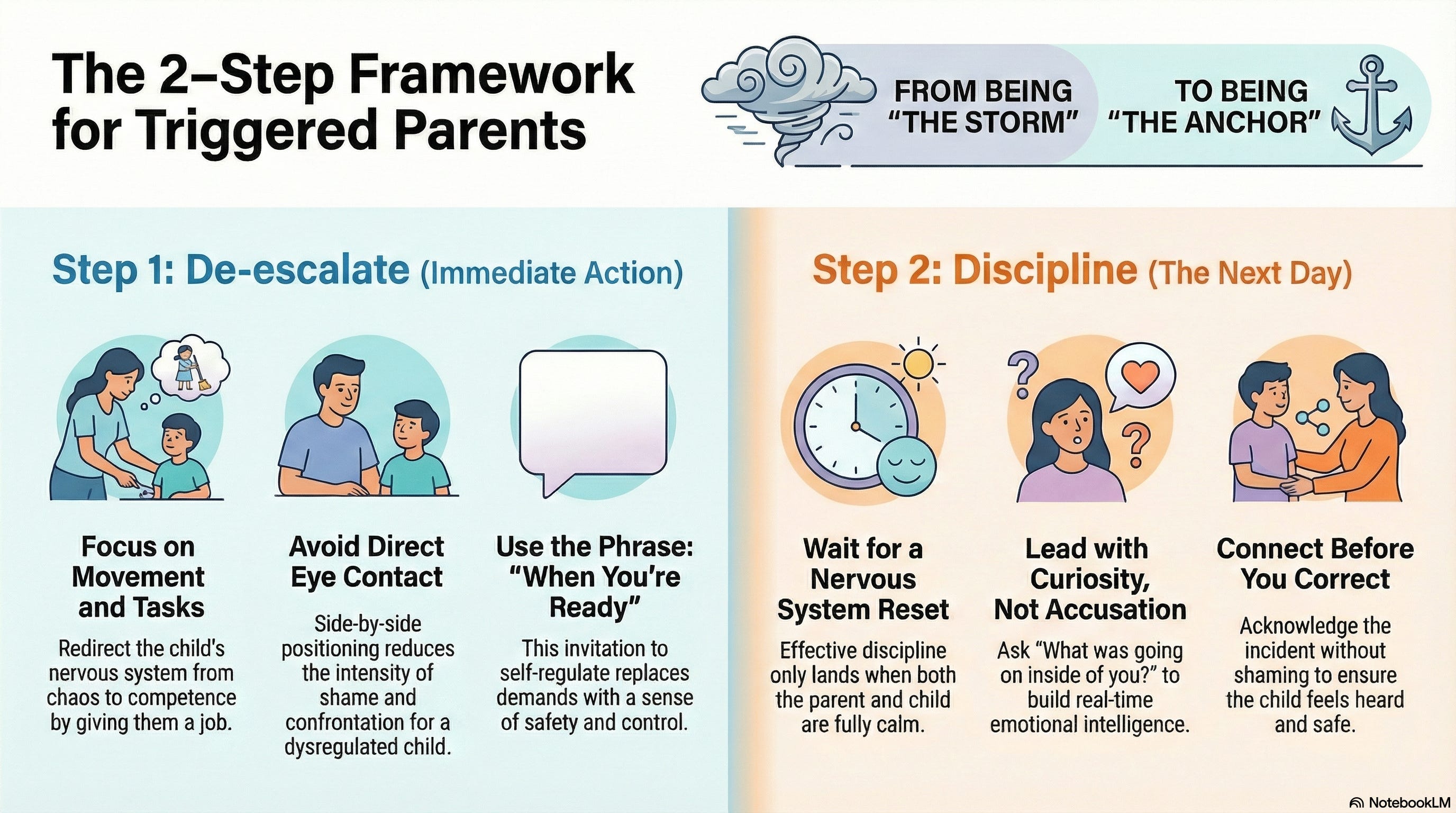
Kirk Martin’s framework is simple, and it’s the opposite of what most of us do instinctively. Most dads (myself included) try to discipline in the heat of the moment, when both you and your kid are dysregulated.
It never works.
The framework is: de-escalate first. Discipline later.
Here’s how that breaks down.
1. De-Escalation: Help Them (and You) Calm Down First
When your kid is melting down (screaming, throwing things, saying hurtful stuff) their nervous system has hijacked them. They’ve lost control. And here’s the part most dads get wrong: trying to reason with a dysregulated child is like trying to negotiate with someone who’s drowning.
They can’t hear you. They’re in survival mode (and probably so are you).
Kirk’s approach is to give them back a sense of control, because that’s exactly what they’ve lost. Not control over you, but control over something.
The specific tactics that stuck with me:
Give them a task.
If it happens at dinner, hand them a job. “Can you put the napkins out?” It sounds too simple. But giving a 6-year-old something to do with their hands redirects their nervous system from chaos to competence.Use movement and tactile input.
Go do something physical together. Walk to the mailbox. Toss a ball back and forth. The movement helps both of you regulate—and doing it together means you’re not standing over them like a judge. You’re beside them.Avoid direct eye contact.
This one surprised me. Kirk explains that for a kid who’s just lost it, direct eye contact feels like confrontation. It amplifies the shame. Sitting side-by-side—in the car, on the porch steps, walking—removes that intensity and lets them come back to themselves.Say: “When you’re ready.”
Three words. No pressure. No countdown. This phrase gives them an invitation to self-regulate instead of a demand. It says: I’m not going anywhere, and you get to decide when you’re okay. That’s the opposite of how most of us were parented—and it’s wildly more effective.
The belief to let go of: that you need to address the behavior immediately or you’re “letting them get away with it.”
You’re not.
You’re creating the conditions where discipline can actually land—because right now, in the middle of the explosion, nothing lands.
2. Discipline Comes the Next Day (Not in the Fire)
This is the part that felt counterintuitive to me.
Every instinct says: deal with it now.
But Kirk’s framework says discipline belongs the next day, when everyone’s nervous system has reset. And it starts with connection, not correction.
The script he suggests (and I’ve now used a version of this with my own kids):
“I know you know what happened wasn’t okay. We’re not ignoring it.”
This acknowledges the incident without shaming them. It tells them: I’m not pretending it didn’t happen, and I’m not ambushing you either.“I’m curious—what made you react that way? What was going on inside of you?”
Not “what were you thinking?” (which is angry, accusatory, and puts them on defence). “I’m curious” is an invitation. “What was going on inside of you” teaches them to look inward instead of outward.
This is where most people get it wrong: they skip the curiosity and go straight to consequences.
But if your kid can explain what triggered them, even partially, even clumsily, they’ve just identified one of their own triggers.
That’s emotional intelligence being built in real time.
No workbook or therapist needed. Just by asking the right question at the right time.
The Real Shift: It Starts With You
Here’s the thing Kirk said that I keep coming back to.
Think about work for a second. If you made a mistake and your boss responded by ripping into you, humiliating you, making you feel small… you’d call that a bad boss.
You’d expect a good leader to stay calm, understand the context, and help you fix it.
Your kid expects the same thing from you. And they’re 6.
The hidden belief that was running my worst parenting moments was: “My children’s behavior is responsible for my emotional state.”
Once I saw that clearly, I couldn’t unsee it.
My kids didn’t make me angry. I was already angry; from work, from being sick, from the accumulated weight of a hard week, and they were just the nearest, easiest target.
Kids feel bad anyway for overreacting.
They already know. They don’t need you to pile on. They need you to be the adult in the room who says: “Your world got out of control. I’m okay. And I’m here to help.” That’s the whole job.
You're Not Broken. You Just Never Got Taught This.
If you’re reading this and you recognize yourself in any of it.
The guilt, the shame spiral, the feeling of watching yourself be the parent you swore you’d never be.
You’re not broken.
You’re just a tired dad who never got taught this stuff.
That’s why I write The Mindful Dad. Every week, I share one honest essay about the real, unglamorous work of staying connected to your kids when you’re running on fumes.
Subscribe to The Mindful Dad, and if this piece hit home, send it to one dad who needs to read it.
Podcast referenced: Calm Parenting Podcast, Episode #492, by Kirk Martin (Celebrate Calm). Highly recommend.